
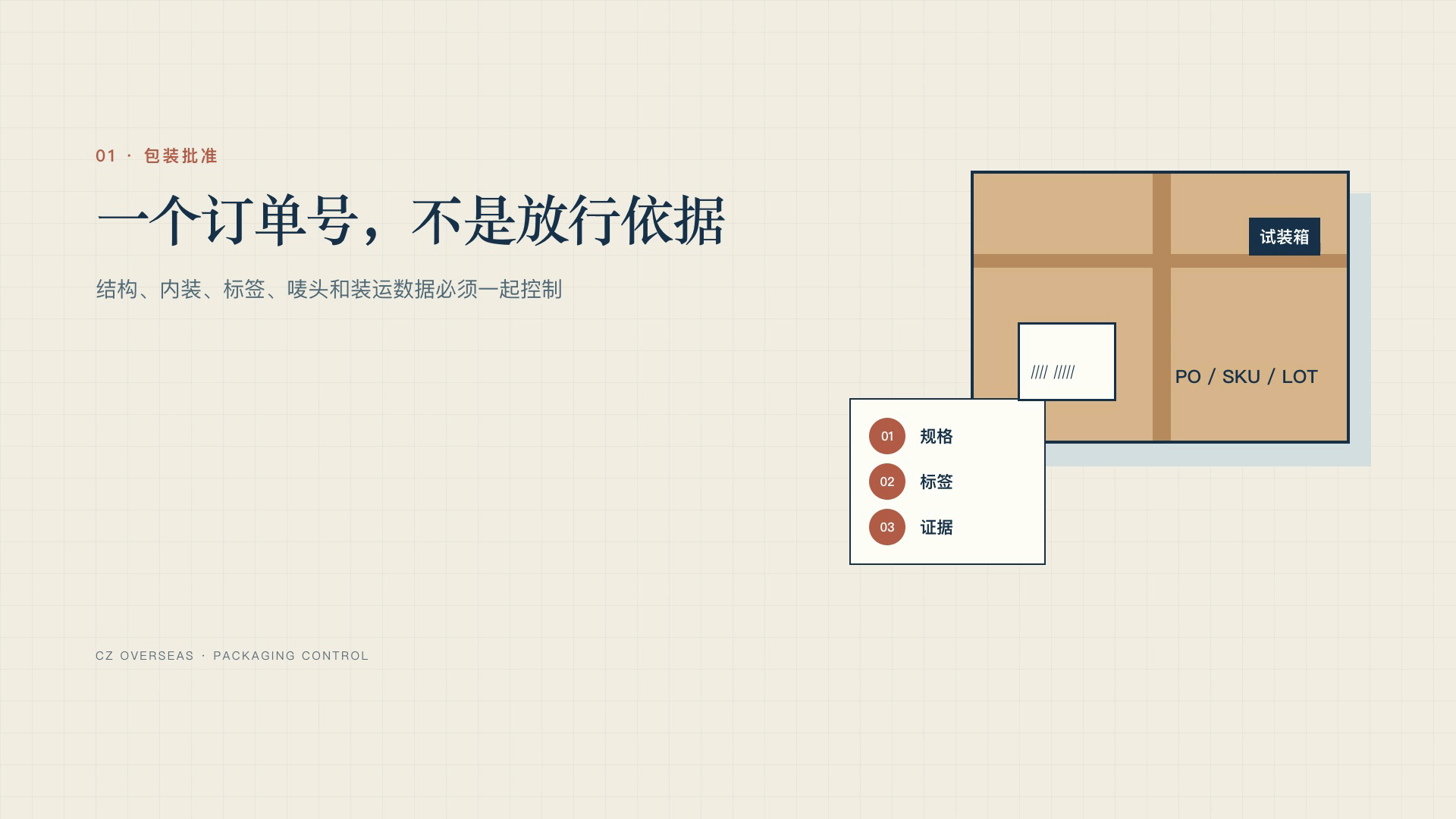
Packaging failures are often version failures. The carton, label artwork, shipping mark, packing list and carrier instruction were approved at different times and no longer describe the same shipment. Use eight gates to keep them aligned.
1. Assign each data source
Separate product and batch data, buyer and order data, and carrier or destination data. Record who provides each field, who approves it and when it becomes frozen. A carrier label should not silently overwrite a buyer label, and a supplier should not guess a destination field.
2. Freeze a measurable packaging specification
Specify units per carton, internal protection, carton construction, dimensions, net and gross weight, cushioning, closure method, pallet configuration and stacking or handling limits. Product, market, dangerous-goods and carrier requirements remain separate controls; a generic checklist cannot decide them.
3. Approve readable text, barcodes and shipping marks
Human-readable information and machine-readable data must agree. Check the SKU, quantity, batch, carton number, destination and buyer instructions. The GS1 Logistic Label Guideline separates supplier, customer and carrier segments and uses an SSCC to identify a logistic unit uniquely. Apply this only where the buyer's system uses GS1 standards; do not invent SSCCs for every order.
4. Build one complete trial pack
Do not approve only a PDF. Pack the real product, accessories, instructions, inner protection and closure materials. Weigh and measure the finished carton, scan every barcode, photograph all sides and the internal arrangement, and reconcile the result with the draft packing list.
5. Check solid wood packaging separately
IPPC ISPM 15 governs solid wood packaging material used in international trade, including many pallets, crates and dunnage, while defining exemptions and treatment controls. Confirm the destination's implementation, material, authorised mark, treatment and repair history. A stamp photo alone is not a complete compliance record.
6. Approve the first production pack
A trial pack can pass while production uses a different carton, printer, tape or operator. When packing starts, approve the first complete production carton for item, quantity, label revision, carton ID, barcode scan, closure, dimensions, weight and appearance before the line continues.
7. Sample by batch and control changes
Set sampling depth by product, packaging complexity, past failures and transit risk. Watch for mixed items, missing labels, duplicate carton IDs, unreadable barcodes, abnormal weights and inconsistent pallets. Any change to specification, destination, buyer label or carrier requirement should trigger a recorded approval for the affected revision.
8. Reconcile three records before release
Compare the physical pack and labels, the commercial invoice and packing list, and the carrier or warehouse data. Carton count, package type, net and gross weight, dimensions, carton IDs and destination should make sense together. Then use the container loading inspection checklist for empty-unit, count, securing, seal and VGM evidence, and the shipping-document checklist for the invoice, packing list and draft bill of lading.
Reusable approval record
- PO, SKU, revision, batch and approvers;
- units per carton, dimensions, weights, materials and closure;
- label file, version, data owner and barcode scan result;
- trial-pack photos, measurements and packing-list reconciliation;
- solid-wood scope, treatment and authorised-mark evidence;
- first-pack approval, batch samples, deviations and corrections;
- final physical, document and carrier-data reconciliation.
Conclusion: approve a deliverable state
Good packaging control is not about adding more labels. It reduces competing versions. Freeze the specification and data, validate a real pack, approve the production start and release only when the physical unit, documents and carrier information agree.
Packaging is ready only when it is readable, scannable, traceable and consistent with the shipment record.
Frequently asked questions
Is a PO number on the carton enough?
No. Reconcile pack quantity, dimensions, weights, label revision, carton IDs, barcodes, packing-list data and carrier information.
Does an ISPM 15 mark alone prove compliance?
No. Confirm scope, authorised application, treatment and repair records, physical condition and destination rules.
Should packaging be checked after trial approval?
Yes. Approve the first production carton and sample the batch according to risk.
Primary sources and boundary
- IPPC · ISPM 15 implementation — official entry for treatment, marking, manufacturing, repair, reuse and import inspection of wood packaging material.
- GS1 Logistic Label Guideline — logistic-unit identification, readable information, barcodes and label segments.
- UNECE Recommendation 1 — official framework for aligned trade and transport document data.
Sources checked 4 September 2026. This is a generic, anonymised order-control method, not a substitute for buyer specifications, carrier rules, destination phytosanitary requirements, product labelling, dangerous-goods rules or the contract.
Put trial-pack, first-pack and pre-release approval into one order record so packaging problems surface before booking cut-off.
Explore the Export Toolkit →