
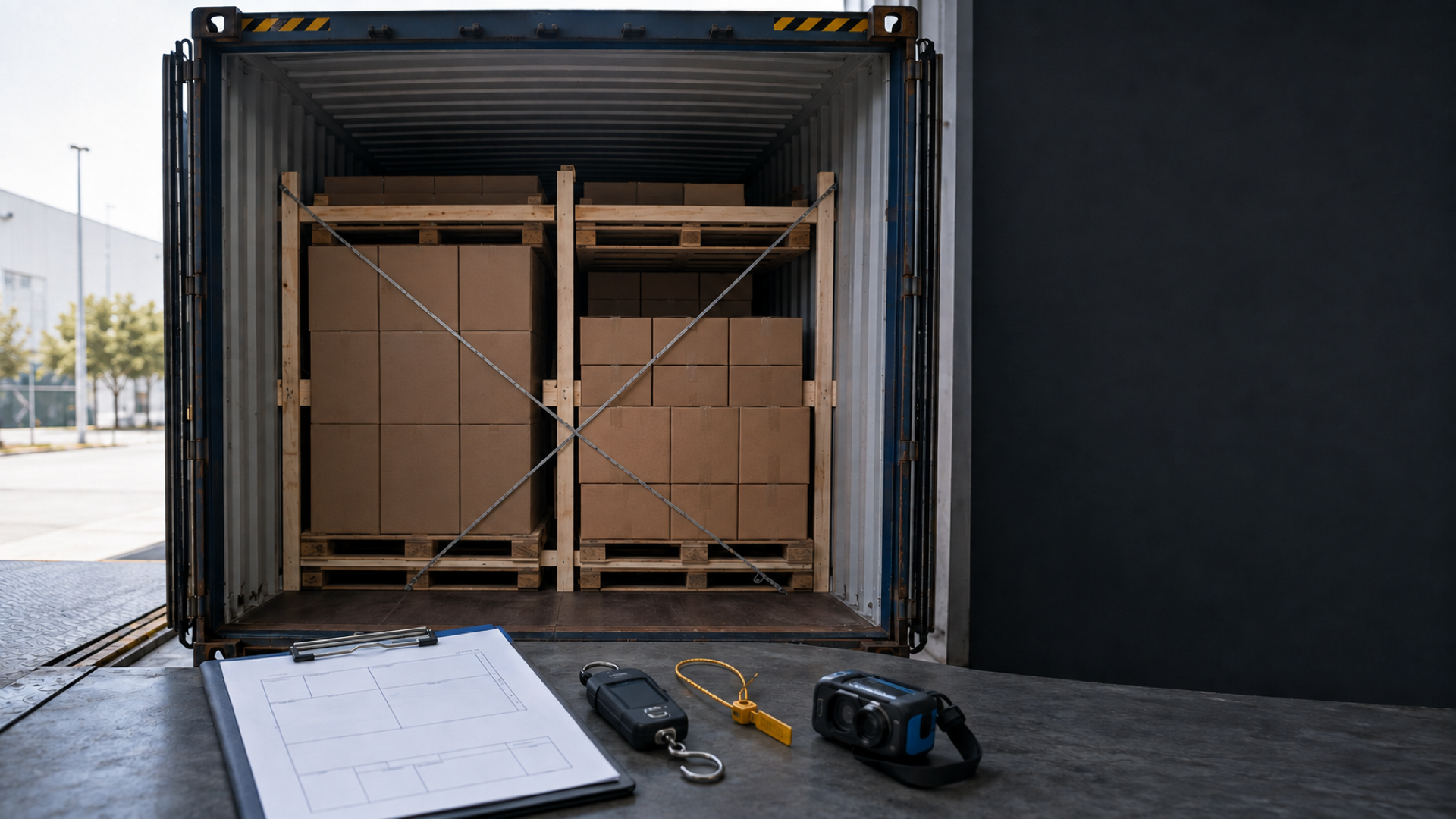
Container loading is the last practical point at which a buyer can still observe much of the shipment before access disappears. A useful inspection brief defines what the observer can verify, what requires a stop-and-call decision and what remains outside the visit.
Which check belongs at which stage?
- Before choosing a supplier: a China supplier evaluation reviews the company, product capability and unresolved order risks.
- Before releasing finished goods: a pre-shipment inspection checks the agreed finished-lot scope against product and acceptance criteria.
- During loading: loading supervision records accessible cargo, counts, visible condition, loading stages and the container and seal identifiers.
- Before the sea-transport handoff: VGM is a separate packed-container weight record, not evidence that the products passed quality inspection.
Agree on access, the counting unit, required photographs, who can pause loading and who approves an exception before booking the visit. If cargo is already sealed or inaccessible, the report must state what could not be observed.
1. Freeze the observation scope before loading day
Issue a brief with the PO, SKUs, lot, approved packaging revision, draft packing list, loading location, time, container type and contacts. Define whether the count is by unit, carton or pallet, which marks need close photographs and which deviations require a hold. Anything outside the agreed scope must not be reported as verified.
2. Link the cargo to an upstream release
Confirm that the staged cargo belongs to the released lot, that corrective actions are closed and that packaging and marks use the approved revision. Loading supervision is normally downstream of packaging approval and a pre-shipment inspection. It cannot turn visible cartons into evidence that all internal units passed quality checks.
3. Record the empty container before cargo enters
Match the container identity and type to the transport plan, then observe doors, locking gear, floor, walls, roof and seals for visible damage, water traces, contamination, odour, protrusions or residue. The IMO/ILO/UNECE CTU Code is a non-mandatory global code of practice; carrier, equipment-owner, dangerous-goods and local requirements still control where applicable.
4. Translate the loading plan into an on-site sequence
Identify heavy, fragile and non-stackable cargo, SKU separation and the intended unloading sequence. Weight distribution, blocking, bracing and lashing should reflect cargo mass, centre of gravity, package strength, route and modes. Heavy cargo can still slide or tip; ordinary straps do not become an adequate securing design merely because they look tight.
5. Count while access still exists
Use carton, pallet or traceable lot references as loading progresses. Record loaded, missing, substituted, damaged and returned quantities rather than reconstructing a count after the doors close. For mixed loads, preserve the relationship between SKUs and locations. If only visible outer packages were counted, state that limitation.
6. Capture loading and securing evidence in stages
Photograph the empty unit, first cargo, intermediate stages, heavy-item positions, fragile protection, void treatment, securing points and the full load before closing. The CTU Code warns that longitudinal, transverse and vertical accelerations can move cargo. Photos document conditions; a competent party must still approve the actual securing arrangement.
7. Reconcile the final count, seal and documents
Before closing, compare actual packages and pallets with the packing list, then record the container and seal identifiers, visible seal condition, exceptions and approvals. If a seal is missing, damaged or different from the documented reference, do not describe the handoff as normal. Escalate to the carrier, shipper and any authority required by the applicable process.
8. Treat VGM as a separate controlled record
IMO explains that packed-container verified gross mass may be obtained by weighing the packed container or by adding cargo, packages, pallets, dunnage and securing material to container tare using a method approved by the competent authority. For SOLAS-covered sea transport, VGM is a condition for loading, but it is not an entitlement to load and is not automatically the packing-list cargo gross weight.
Minimum evidence pack
- PO, SKU, lot, packaging revision and upstream release reference;
- location, time, container type and identity, and responsible contacts;
- empty-container observations and exceptions;
- staged and loaded counts, substitutions, damage and cargo locations;
- loading sequence, void treatment, blocking, bracing and lashing evidence;
- final overview, seal close-up, seal reference and document revision;
- VGM method, value, responsible submitter and handoff time.
Conclusion: loading supervision is a chain of evidence
It does not guarantee product quality, engineering adequacy or regulatory compliance. It does make the handoff reviewable: the correct visible cargo entered the intended container, exceptions were recorded before access disappeared, and the final identifiers and weight data reconcile.
The closed doors are the end of the record—not the beginning of proof.
Frequently asked questions
What does container loading inspection in China cover?
Container loading inspection records the agreed visible cargo, package count, empty-container condition, loading sequence and seal handoff. The report should identify the shipment, attach dated evidence, record exceptions and state anything inaccessible or outside the agreed scope.
Does container loading supervision replace a pre-shipment inspection?
No. It observes accessible cargo, packaging, count, container condition, loading and seal handoff; it does not verify every product characteristic or a statistically sampled finished lot.
Do loading photos prove that cargo is safely secured?
No. Photos document visible conditions. A competent responsible party must confirm the loading and securing method for the cargo, route, transport modes and applicable requirements.
Can packing-list gross weight be used as VGM?
Not automatically. Packed-container VGM includes container tare plus cargo and applicable packages, pallets, dunnage and securing material.
Primary sources and boundaries
- IMO: CTU Code — the non-mandatory IMO/ILO/UNECE global practice for packing and securing cargo transport units.
- MSC.1/Circ.1497: full CTU Code — container checks, loading, securing, seals and chain-of-responsibility guidance.
- IMO: verification of packed-container gross mass — shipper responsibility, two verification methods and the loading condition.
Sources checked on 5 September 2026. This is a generic, anonymized buyer-control guide, not an inspection certificate or a substitute for carrier, equipment-owner, customs, dangerous-goods, insurance, contract, professional stowage or cargo-securing requirements.
Write observation points and stop conditions into the loading brief before the truck arrives.
Open the Export Toolkit