
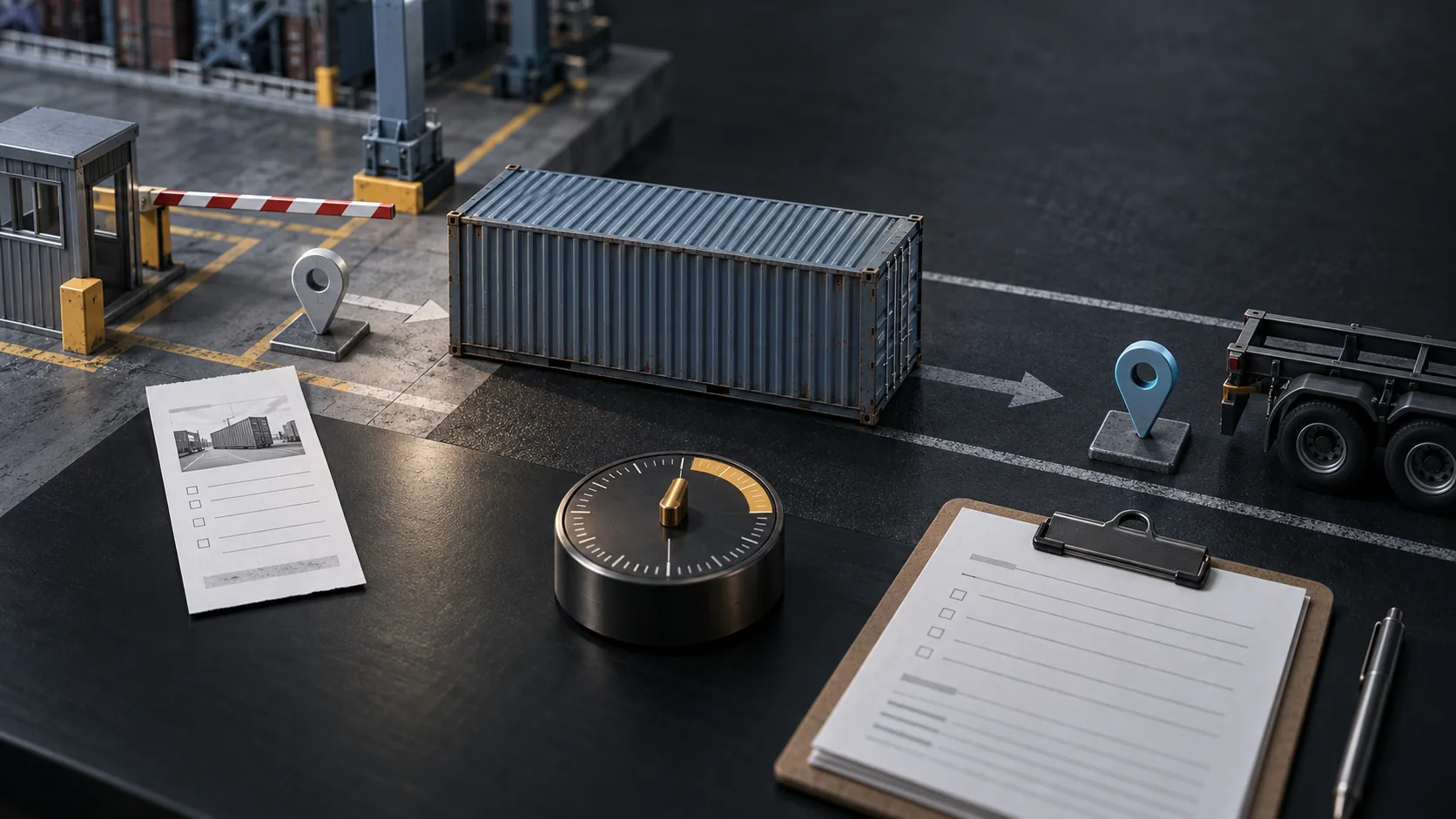
A buyer may hear that a shipment has “seven free days” without learning which clock those days belong to. Maersk defines free time as the agreed period during which demurrage, detention or storage does not apply, then separates terminal time from time outside the terminal. The exact labels, events, combined-time arrangements and tariffs still vary by carrier, country and customer agreement.
1. Draw the import or export event line
For an export from China, map empty-container release, full gate-in and vessel loading. For an import, map discharge, cargo availability, pickup and empty return. Record the booking and container number against each event.
2. Separate the terminal clock from the outside clock
Under Maersk's published definitions, export demurrage covers a full container held inside the terminal before loading beyond free time; export detention covers the period from empty release until full gate-in. Import demurrage covers time inside the terminal after discharge; import detention covers time outside until empty return. Your carrier may use combined time or different labels, so use the terms that govern the shipment.
3. Confirm the free-time rule in writing
Capture the number of days, calendar or working-day basis, whether the first day counts, the last free day, holiday treatment and the tariff version. A forwarder's informal “normally seven days” should remain unconfirmed until the applicable rule is identified.
4. Preserve the timestamps that can prove the timeline
Keep terminal events, carrier notices and depot receipts. Also record terminal closure, unavailable appointments, container damage or changed carrier instructions with a reference number and contact. These records are more useful than a reconstructed timeline after an invoice arrives.
5. Assign each hand-off
Name the shipper, consignee, forwarder, trucker, warehouse and carrier owner for every milestone. Give the owner an alert time, an escalation deadline and a backup contact. Use the freight-booking hand-off checklist to align the inputs before the container moves.
6. Estimate exposure with the applicable local tariff
Calculate each day against the tariff and tier that applies to the container, location, equipment, customer and dates. Record currency and taxes. A generic table can flag risk, but it cannot confirm the final amount. Reconcile quote scope separately with the ocean freight surcharge guide.
7. Review or dispute the invoice container by container
Match the charge type, free days, start and end dates, tariff tier and evidence for each container. If an item remains disputed, retain the invoice, governing terms, terminal records and notices, then follow the carrier's channel and deadline.
Copy this seven-line control record
- Booking / container / import or export: ___.
- Carrier, terminal, route and terms version: ___.
- Demurrage free time, events and last free day: ___.
- Detention free time, events and last free day: ___.
- Actual timestamps and evidence references: ___.
- Owner, alert time and escalation contact: ___.
- Applicable tariff, estimated exposure and invoice-review status: ___.
A specific boundary for U.S. trades
For invoices within U.S. Federal Maritime Commission jurisdiction, check the current billing rules as an additional layer. The FMC says a 2025 court decision vacated only the rule on who may be billed in 46 CFR 541.4; the remaining requirements, including the 30-day issuance requirement and sufficient, accurate invoice information, remain in effect. This U.S. rule does not automatically govern other countries or every transport arrangement.
Sources and limits
Verified 29 September 2026. Definitions and local variation: Maersk Demurrage & Detention terms and Maersk D&D FAQ. U.S. boundary: FMC advisory on the 2025 court decision. This is an operational review method, not legal advice, a carrier quotation or a waiver promise. No customer container or invoice data was used.
Frequently asked questions
Are demurrage and detention the same charge?
Usually not. They generally refer to different container-location stages, but the governing carrier terms control.
When does container free time start?
There is no universal start event. Confirm the shipment direction, location, tariff and day-count convention.
Can a generic online tariff confirm the final charge?
No. Use the local tariff and customer terms applicable to the container, route and dates.
Need to reconcile a container timeline?
Start with the Export Toolkit, then contact Chris to discuss the review path. Do not send customer, container or invoice-sensitive data through a public message.