
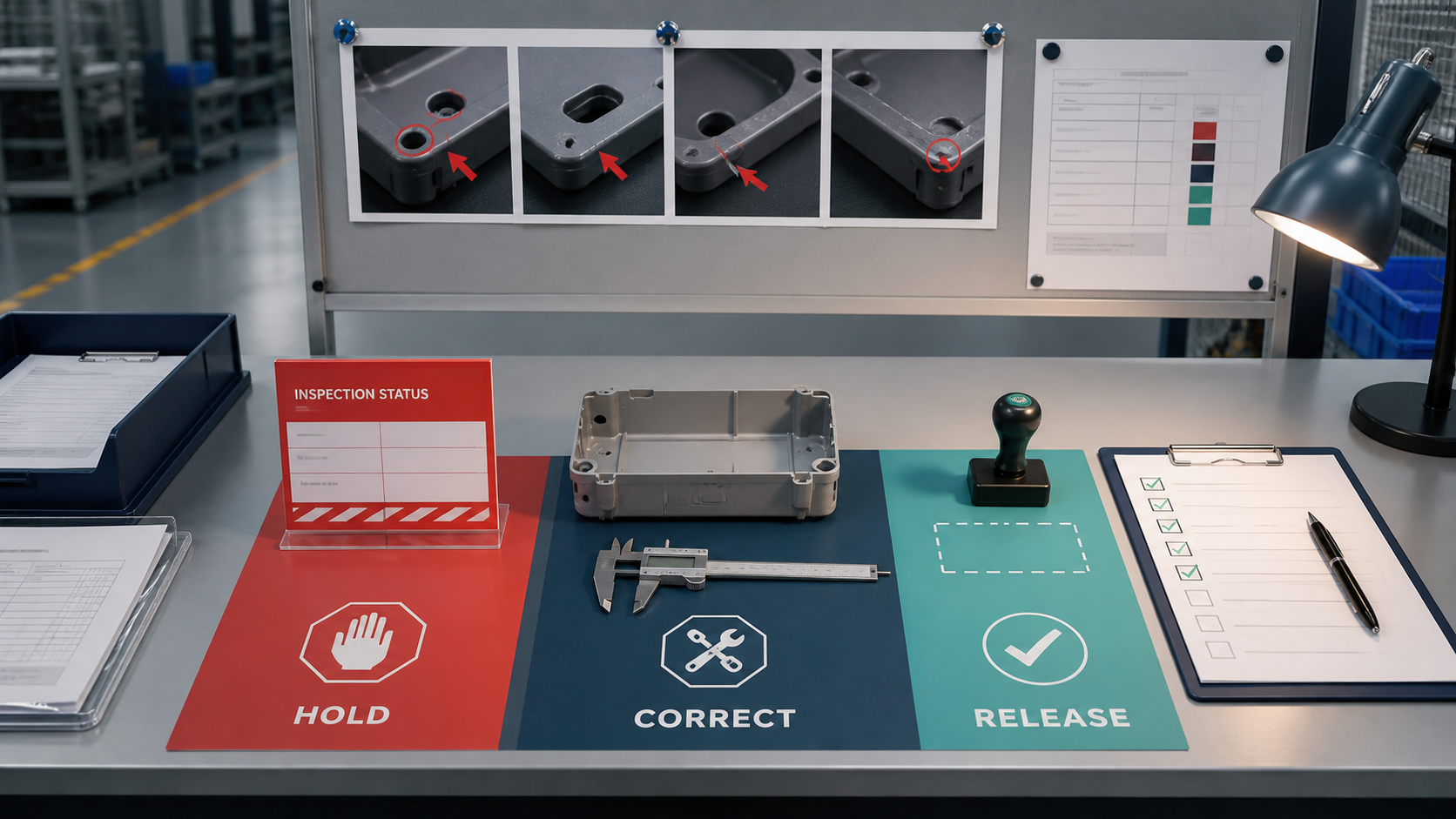
A “Fail” on a pre-shipment inspection report should not trigger an immediate shipment, an automatic legal rejection or a photo-only rework claim. It should trigger a controlled disposition process.
First hold the release. Verify that the report covers the correct purchase order, lot, product revision and sampling plan. Then classify the issues, contain affected product, determine causes, implement corrective action and choose evidence review or reinspection. The final decision must identify the lot, report revision, open risks and approver.
1. Put the shipment on hold—without pretending the commercial decision is final
Change the order status to Hold and pause final packing, loading approval or document release within the agreed control point. Notify the supplier, buyer, quality and logistics owners with the report number and affected lot.
A hold preserves evidence and options. Rejection, rework, replacement, concession, deduction or claim depends on the purchase contract, approved specification, inspection agreement and applicable law.
2. Verify the report identity and inspection basis
Check the PO, SKU, model, colour, lot quantity, inspection location, completion status, date, sample size, inspection level, AQL, approved specification and report revision. Confirm that photos and measurements map to identified samples.
If the wrong revision or sampling basis was used, correct that before arguing about the result. The factory audit and pre-shipment inspection guide covers the upstream service and scope decision.
3. Separate defect severity from the sampling decision
Critical, major and minor classifications express risk and business consequence. The sampling plan sets sample size and acceptance or rejection thresholds for the defined lot. They are related controls, not interchangeable labels.
ISO 2859-1:2026 provides AQL-indexed, lot-by-lot attribute sampling schemes. NIST notes that acceptance sampling is used to decide the disposition of a lot, not to estimate its exact quality. Three defects in a sample do not prove an exact lot-wide defect percentage. Use the AQL inspection sampling checklist when the plan itself needs to be defined.
4. Contain known risk before investigating causes
Segregate the inspected lot and identified nonconforming units. Stop the same process where appropriate. Trace work in progress, packed stock, shared materials, tooling, fixtures and adjacent lots when the same cause may affect them.
Document the quantity, location, labels, owner and time of containment. Containment prevents further escape; it does not prove that the cause has been removed.
5. Distinguish rework, correction and corrective action
Reworking or replacing observed product corrects the detected output. Corrective action addresses why the nonconformity occurred and why the process did not prevent or detect it earlier.
Ask three questions: Why did it happen? Why did the process control miss it? Why was it not detected before PSI? Check drawing revision, first-article approval, machine parameters, fixtures, gauges, incoming material, work instructions and change records.
6. Turn the plan into verifiable tasks
Use a corrective-action log with: issue and evidence, severity, affected scope, containment, cause, permanent action, owner, due date and acceptance evidence. Define quantities and measurable results before the supplier starts rework.
The plan should cover the affected process or population, not only the sampled pieces in the report. It should also prevent rework from creating new dimensional, cosmetic, packing or mix-up defects.
7. Choose evidence review, targeted verification or reinspection
For a low-risk, clearly bounded issue, the buyer may review a traceable rework list, continuous evidence, measurement records and approved-sample comparison. Critical, safety, regulatory, systemic or poorly evidenced issues usually justify independent reinspection.
Define the method before the visit: inspect all reworked units, expand checks on one characteristic, or draw a new random sample for a lot decision. Do not allow the supplier to present only its best carton or reuse one old photo to close several findings.
8. Release through a written disposition
Record one disposition: accept, accept after verified rework, accept under a documented concession, or reject and replace. Identify the lot, report and corrective-action revisions, remaining risks, commercial treatment, approver and date.
A concession should be limited to a named lot and condition. It must not silently rewrite the product specification for future orders, and it cannot waive mandatory safety or regulatory requirements.
A practical failed-inspection disposition record
- PO, SKU, lot and report revision.
- Critical, major and minor findings with evidence IDs.
- Sample result, sampling plan and lot disposition.
- Containment scope, rework quantity and stock location.
- Cause, permanent action, owner and due date.
- Verification method, scope and pass criteria.
- Final disposition, commercial action and written approval.
Five mistakes to avoid
- Treating “Fail” as proof that every unit is bad—or correcting only the photographed samples.
- Using AQL as a substitute for defect severity, specifications or regulations.
- Accepting selected photos without batch-level quantities and traceability.
- Booking reinspection before defining its scope and pass criteria.
- Shipping first and trying to reconstruct approval after departure.
Conclusion: close evidence, not just report rows
The value of PSI is not a red or green label. It is the decision chain it enables: hold, verify, classify, contain, investigate, correct, verify and release.
A failed report is not the final answer. An “issue closed” statement without lot, evidence, owner and verification gate is the start of the next failure.
Frequently asked questions
Does a failed AQL inspection mean the whole lot is defective?
No. It supports a disposition decision for the defined lot; the sample count is not an exact lot defect rate.
Must the buyer always book a reinspection?
The contract, buyer and risk determine the method. High-risk or weakly evidenced issues normally justify independent reinspection.
Are supplier photos enough?
They can support closure when they identify the lot, quantity, issue and time. Selected photos alone are weak evidence for systemic or high-risk findings.
Does a concession change future specifications?
No. Limit it to the stated lot and condition; future orders remain controlled by the approved specification and written changes.
Primary sources and boundaries
- ISO 2859-1:2026 — AQL-indexed sampling schemes for lot-by-lot inspection by attributes; the 2026 third edition replaces the 1999 edition.
- NIST Engineering Statistics Handbook: Acceptance Sampling — lot disposition rather than exact quality estimation.
- ISO/TC 176 quality-management resources — the management-system context for nonconformity, correction and corrective action.
Sources checked on 2 September 2026. This generic, anonymized buyer workflow does not replace the contract, inspection-agency rules, product regulations, laboratory judgement or legal advice. Escalate safety and regulatory findings to qualified owners.