
AI agents are often described as smarter chatbots or digital workers that can operate software. Both descriptions capture part of the idea, but neither explains what makes an agent useful in real business operations.
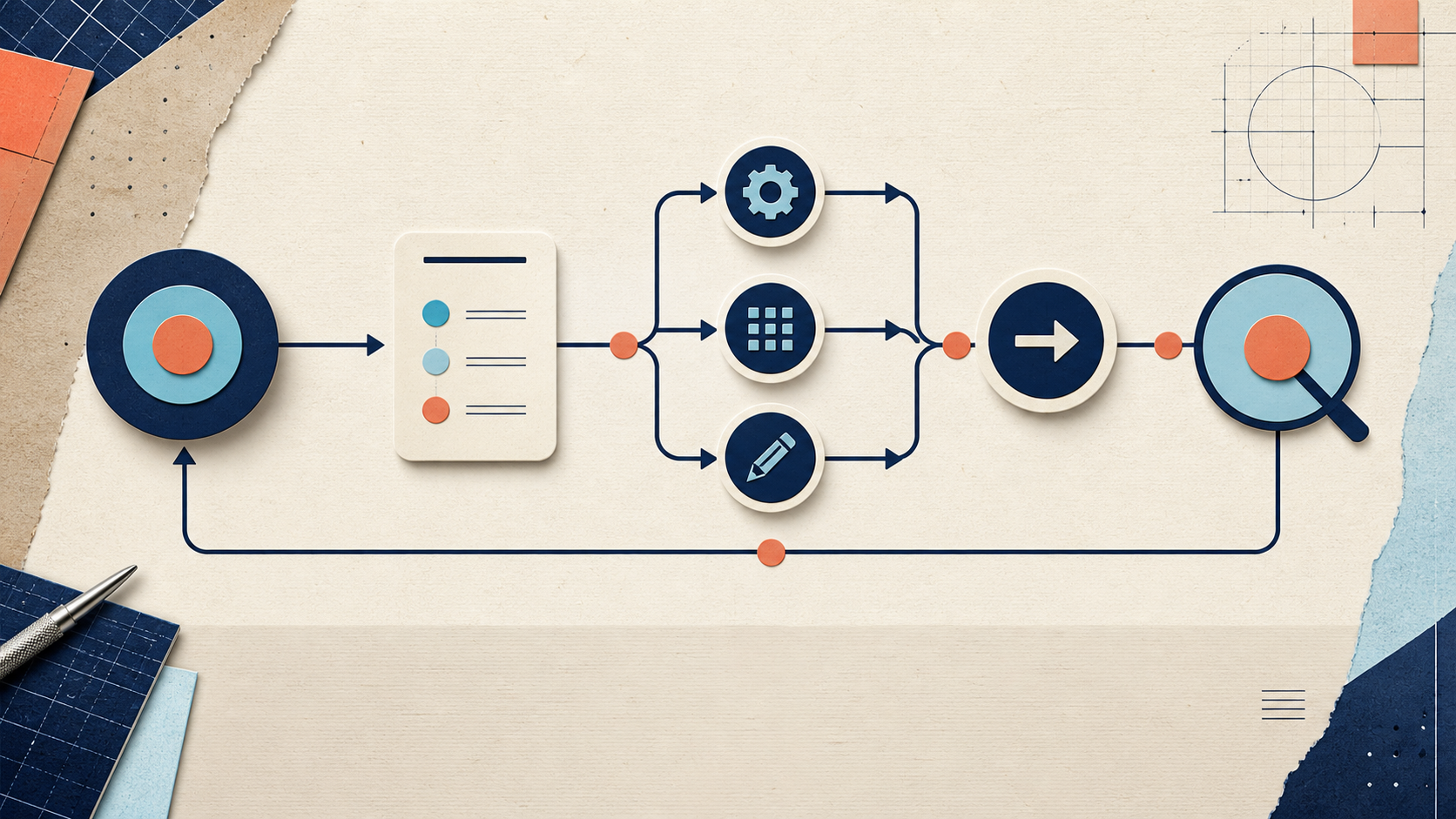
A practical AI agent does more than produce an answer. It works toward a goal, reads relevant information, uses tools, observes what happened, and then decides whether to continue, adjust, retry, stop, or ask a person to take over.
A simple model: LLM, context, and tools
A useful engineering model for modern agents has three parts:
- The LLM is the decision engine. It interprets the current state and chooses the next step.
- Context determines what the agent can see. This includes the goal, rules, history, knowledge, and results returned by tools.
- Tools determine what the agent can do. Examples include search, data retrieval, file creation, and controlled actions in business software.
Connecting a model to a tool is not enough by itself. The important step is closing the feedback loop: the agent must use the result of one action to make the next decision.
Chatbot, fixed workflow, or agent?
| System | Typical behavior | Best fit | Main limitation |
|---|---|---|---|
| Chatbot | Generates a response to the current request | Q&A, explanation, drafting | Usually does not execute or verify a process |
| Fixed workflow | Follows predefined steps | Stable, rule-based processes | Handles exceptions poorly |
| AI agent | Selects the next action from goals and feedback | Tasks with variable paths, tools, and judgment | Higher cost, risk, and governance needs |
Not every automation should become an agent. If deterministic rules can complete a process reliably, a fixed workflow is often cheaper and easier to audit. Agentic behavior is most valuable when the path changes with new information and the result can still be checked.
Why a strong model can still fail
An agent can fail even when the underlying model is capable. Common failure points include:
- The objective or completion criteria are unclear.
- Context contains outdated, conflicting, or irrelevant information.
- The agent selects the wrong tool or passes incorrect parameters.
- A tool fails, but the failure is not returned clearly to the model.
- The agent declares success before every requirement is verified.
- Excessive permissions turn a small mistake into an external business impact.
Production systems therefore need a runtime and governance layer around the model. It should limit actions, preserve an audit trail, verify outcomes, and provide recovery, rollback, or human-escalation paths.
Good first pilots for an export team
A sensible first pilot has a narrow scope, clear inputs, verifiable outputs, and recoverable failures. Examples include:
- summarizing inquiries and suggesting follow-up actions without sending quotations or promising lead times;
- collecting public prospect information with source links, without automatically sending bulk outreach;
- checking an article for missing evidence and SEO structure while keeping publication subject to review;
- flagging order, logistics, or after-sales exceptions without issuing payments or refunds;
- extracting candidate SOPs from past projects and requiring human approval before they enter the official knowledge base.
These tasks can create measurable time savings without immediately exposing customers, funds, or production systems to autonomous decisions.
Six questions to ask before adopting an agent
- What is the objective, and how is completion verified?
- What data can the agent access, and how are freshness and permissions controlled?
- Which tools can it use, and which actions affect external systems?
- What happens when a tool fails or sources conflict?
- Who verifies the result, and are sources and actions logged?
- Which situations require the agent to stop and hand control to a person?
A successful demonstration is not the same as production reliability. Permissions, failure handling, verification, and human takeover are part of the product—not optional details.
Start with a verified loop, not maximum autonomy
The value of an AI agent is not that it appears human. Its value is the ability to move a task through an observable, actionable, and verifiable loop.
For a small export team, the safer approach is to begin with one specific task. Give the agent only the information and permissions it needs, define acceptance criteria, keep human review and rollback available, and expand only after real results justify the next step.
Frequently asked questions
Is an AI agent the same as ChatGPT?
Not exactly. ChatGPT can provide the model and conversational interface, while an agent usually adds task state, context management, tools, feedback loops, permissions, and verification.
Does any tool-using assistant count as an agent?
Not necessarily. A one-time tool call may simply be a tool-enabled assistant. Agentic systems use results to make subsequent decisions and continue working toward a goal.
Does a small business need multiple agents?
Usually not at the beginning. One agent with clear tools and acceptance checks is easier to control. Multiple agents make sense only when independent information, permission separation, or genuine parallel work creates enough value to justify the complexity.
Primary sources and scope
- Anthropic: Building effective agents — workflow and agent distinction; start with the simplest workable pattern.
- OpenAI: A practical guide to building AI agents — model-led workflow, tools, guardrails, and human intervention.
- Google Cloud: Choose your agentic AI architecture components — models, tools, memory, and when a non-agentic design is sufficient.
- NIST AI RMF Generative AI Profile — a voluntary risk-management reference, not a mandatory certification.
Sources were checked on 25 August 2026. This guide explains operational design choices; it does not promise ROI, employee replacement, or risk-free autonomy.