
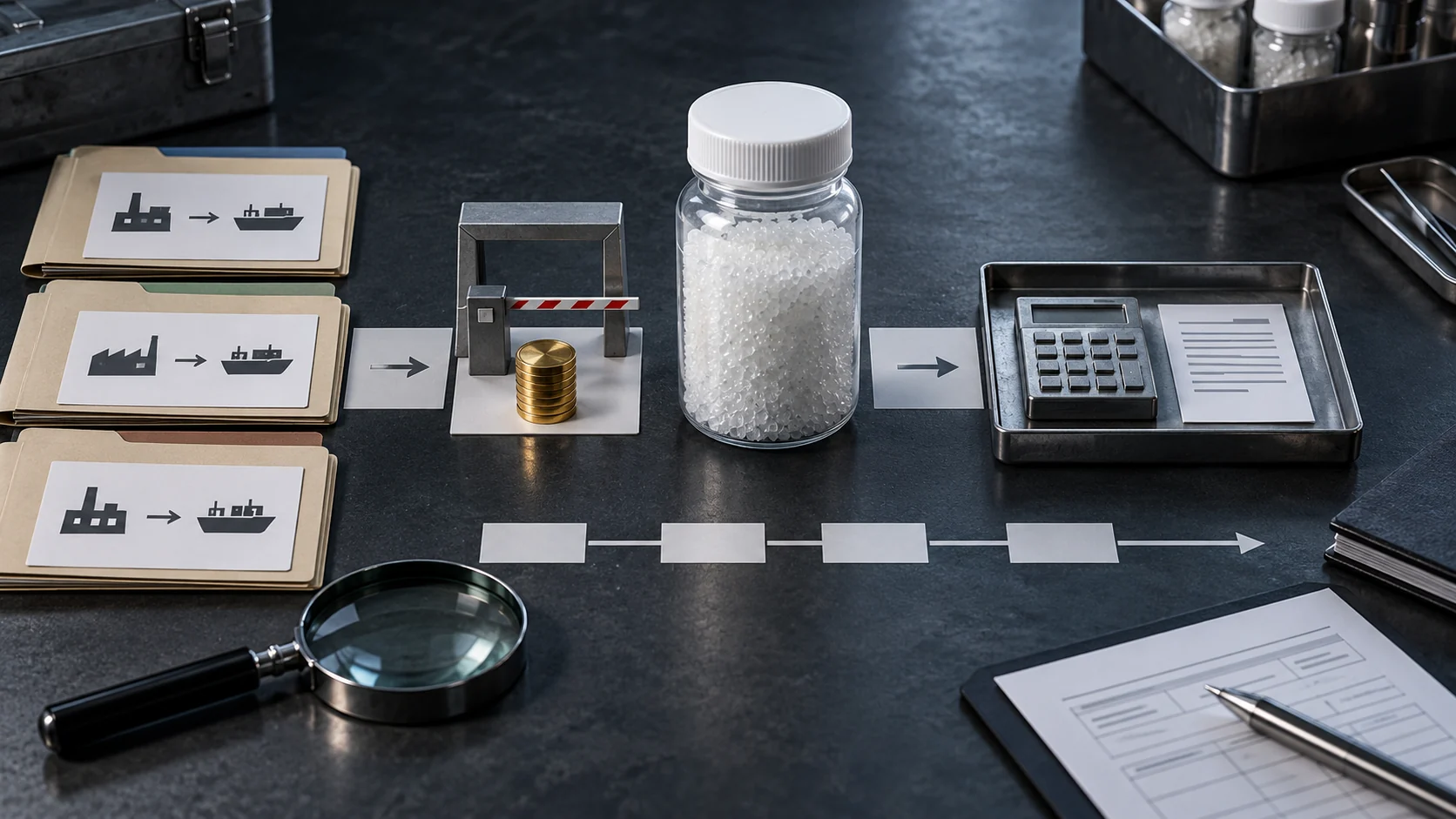
On 5 October 2026, the U.S. Department of Commerce published the final results of its 2024 countervailing duty administrative review of certain corrosion inhibitors from China. The notice lists three rates and separates assessment of reviewed entries from cash deposits on new entries. It is a useful worked example of a wider import-control problem: a final review rate, a cash deposit and the amount ultimately liquidated are related, but they are not interchangeable.
Collect four inputs first
The controlling written scope; actual producer and exporter; U.S. entry number and entry date; current Commerce result and CBP instructions. Record missing input as unknown, with an owner and next action. Never replace missing evidence with zero.
1. Identify the procedural stage
This is a final administrative-review result in case C-570-123 for the period 1 January through 31 December 2024. Commerce describes two follow-on paths: assessment instructions for relevant reviewed entries, and cash-deposit requirements for subject merchandise entered or withdrawn for consumption on or after 5 October 2026.
2. A cash deposit is not final duty liability
The deposit secures funds when merchandise enters. Final liability is determined later through the review and liquidation process, subject to valid instructions and possible court proceedings. A landed-cost file should label each figure as a current deposit assumption, a review result or a liquidated final amount.
3. Match each rate to the listed company
| Company listed by Commerce | Final net subsidy rate | Review boundary |
|---|---|---|
| Anhui Trust Chem Co., Ltd. | 18.64% | Use only after matching scope, company identity, entry date and current instructions |
| Nantong Botao Chemical Co., Ltd. | 48.45% | Do not transfer to a similarly named or unverified affiliated entity |
| Connect Chemicals GMBH, Gold Chemical Limited and Kanghua Chemical Co., Ltd. | 36.40% | Review-specific average for the non-selected companies |
Commerce states that companies not covered by this review continue under the all-others rate or their most recent company-specific cash-deposit rate. Product similarity alone does not establish a rate.
4. Verify the producer-exporter chain
Record the producer's full legal name, exporter, invoice party, U.S. importer and any known affiliation. Compare that chain with the final-results table, historical rate records and current CBP instructions. A supplier's trading name or sales invoice does not prove that the lowest listed rate applies.
5. Use the entry date to separate old assessment from new deposits
Entries within the review period raise an assessment question. Subject merchandise entered or withdrawn for consumption after publication raises the current cash-deposit question. Quote date, bill-of-lading date and sailing date are not substitutes for the U.S. entry date. The importer or broker should provide the entry number, entry date and liquidation status.
6. Read the 35-day and 90-day timing carefully
Commerce says it intends to issue assessment instructions no earlier than 35 days after publication. If a summons is filed at the U.S. Court of International Trade within the statutory 90-day period, an injunction request may affect liquidation timing. The 35 days are not a rate-selection grace period, and 90 days do not automatically suspend every entry.
7. Assign fields to the responsible party
- Supplier or exporter: product specifications, producer, exporter, invoice party, order and shipment evidence.
- U.S. importer or broker: entry number, entry date, deposit treatment, liquidation status and CBP messages.
- Trade counsel: written scope, entity treatment, court status and instruction applicability.
- Output: one entry-level record with evidence version, deposit assumption, unknowns, owner and next review trigger.
A complete worksheet does not prove that merchandise is in scope, that a company rate applies or that CBP will release an entry. It creates a reviewable record.
8. Put review triggers into pricing and purchase controls
Track a new Commerce result, CBP instruction, court injunction or decision, and any change in product, producer or exporter. Separate product price, known duty assumptions and unresolved adjustments in the cost model. Name the person responsible for confirming each assumption and the date it must be refreshed.
Source, comparison and unknowns
Source facts: Commerce lists the case, review period, five companies, three rates, assessment and deposit rules, and the 35-day and 90-day timing. CZ Overseas judgment: import teams should connect scope, entity chain, entry and stage in one record. Unknown here: without a specific entry, CBP message and historical company rate, this article cannot determine the actual deposit or final duty for a shipment.
Primary source: Federal Register document 2026-20282; checked 5 October 2026. This is a public-information review framework, not a scope ruling, customs instruction or legal opinion.
Frequently asked questions
Is the cash deposit the final CVD amount?
No. The deposit is collected at entry; final liability follows review, assessment instructions, liquidation and possible litigation.
Can the lowest company rate be used for similar goods?
No. Match written scope, the producer-exporter chain, entry date and current instructions.
Does a complete file confirm rate eligibility?
No. It provides the inputs for review. The actual result still depends on the official record and entry facts.
What this guide helps the reader complete
China suppliers can replace a single unsupported “U.S. duty rate” with a traceable set of product, entity, date and stage facts. U.S. importers can assign the current deposit and later liquidation to the right owners and avoid treating a review result as the fixed final cost for every shipment.
Build the review into your import workflow
Start with the U.S. AD/CVD scope check, then use the toolkit to align evidence fields. Contact Chris to discuss how public case records and internal order evidence can be separated. Do not send customer, entry or payment-sensitive records through a public message.