
Freight quotation · 10 min read · 9 Sep 2026
How to Calculate CBM and Chargeable Weight for Shipments from China
Freight surprises often start with an unaligned carton size, unit, dimensional divisor or rounding rule. Build a verifiable shipment dataset first, then confirm the carrier's billing basis in writing.
About 112 seconds
Do not quote freight from gross weight alone
Use one carton example to separate CBM, dimensional weight and the carrier's chargeable-weight rule.
Open the standalone video page →Keep three fields separate. CBM is the space the packed shipment occupies in cubic metres. Actual weight comes from a scale. Chargeable weight comes from the selected mode, service and carrier rules. Express or air services often compare actual and dimensional weight; LCL ocean freight may use weight-or-measure terms.
1. Measure the shipment in its final packed condition
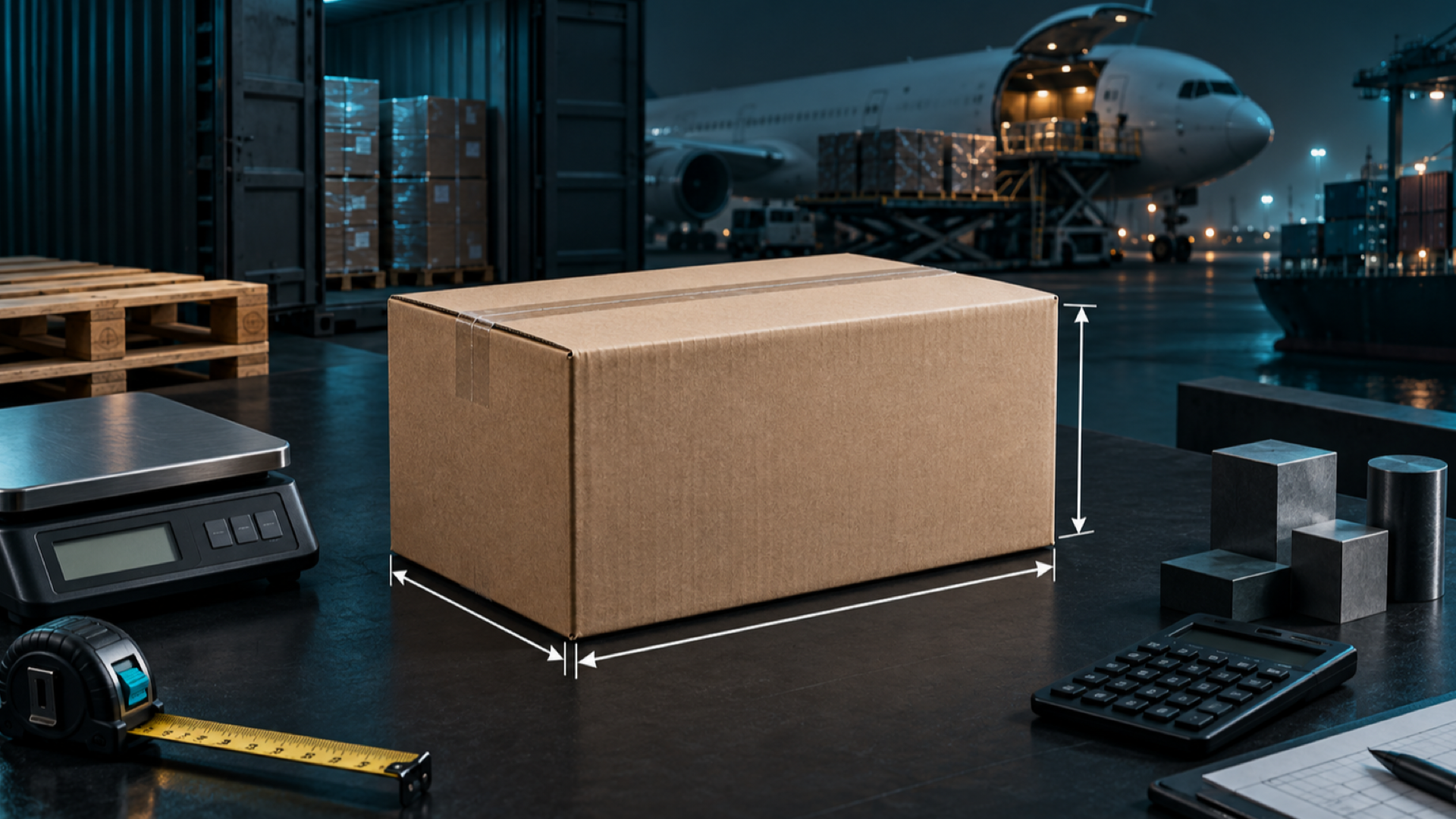
Measure the longest, widest and highest external points, including bulges, corner protectors, straps and pallets. Do not use internal carton dimensions or the bare product size. Record the unit, date and measuring party because carrier scans can change the billed result.
2. Group cartons by size
For each carton type, record quantity, external dimensions, gross weight per piece and total gross weight. Calculate each group before adding totals. An average carton can hide an oversized piece or a light, bulky carton.
3. Calculate CBM in metres
CBM per carton = length × width × height in metres. A 60 × 40 × 50 cm carton is 0.6 × 0.4 × 0.5 = 0.12 CBM. Ten identical cartons total 1.20 CBM. Keep units consistent.
4. Use the confirmed dimensional divisor
DHL Express and some FedEx and UPS international examples use length × width × height in centimetres ÷ 5,000 to produce kilograms. The example carton therefore produces 24 kg. The divisor can vary by carrier, service, mode, origin, destination and contract, so 5,000 is not a universal promise.
5. Compare actual and dimensional weight
If that carton weighs 18 kg but its confirmed dimensional weight is 24 kg, an express example would normally use the higher 24 kg as the billing basis. Ask whether the comparison is per piece or per shipment and how fractions, minimum billable weights, oversized pieces and pallets are handled.
6. Treat LCL ocean freight separately
Do not apply an express divisor to LCL by default. One Maersk LCL contract example calculates volume in CBM or weight-and-measure units and uses the higher gross volume or gross weight, with 1 CBM equal to 1,000 kg under those terms. Your actual quote can also include lane-specific minimums, origin, destination and local charges.
7. Put billing assumptions into the RFQ
Ask the forwarder or carrier to confirm the divisor, rounding, per-piece or shipment method, minimum charge, oversize or overweight rules, fuel, remote-area, peak, customs, storage and destination charges. A rate per kilogram without these assumptions is not a complete freight quotation.
8. Re-measure before handover
Recalculate after any packaging, carton-count or pallet change. Before handover, sample-check carton types, total pieces, gross weight and CBM against the packing list and booking handoff. Keep measurement photos and a versioned record to resolve remeasurement differences.
Minimum freight-calculation record
- Carton type, quantity and maximum external dimensions;
- CBM and gross weight by piece and total;
- Mode, carrier, service and lane;
- Dimensional divisor, rounding and comparison method;
- Actual, dimensional and final chargeable weight;
- Minimums, oversize and other surcharges;
- Quote validity, data version and approver.
Frequently asked questions
What does CBM mean?
CBM means cubic metre. Multiply packed external length, width and height in metres, then multiply by the number of identical cartons.
Is chargeable weight always gross weight?
No. Express and air services often compare actual and dimensional weight, but the exact rules depend on the carrier and service.
Can I use divisor 5,000 for LCL?
Do not assume so. LCL can use weight-or-measure rules, minimums and lane-specific charges. Confirm the written quote.
Primary sources and limits
- DHL Express — Weight and Dimensions: dimensional-weight example and higher-of-two billing basis.
- UPS Supply Chain Solutions — Chargeable & Volumetric Weight: the dimensional factor varies by mode or trade lane.
- FedEx — What is Dimensional Weight?: external package measurement methodology.
- Maersk — LCL Terms: a CBM and WMU contract example.
Sources checked 9 September 2026. This is a generic, anonymised calculation and handoff framework—not a carrier quotation, rate promise, customs, tax or legal opinion. Carrier, service, route, contract and remeasurement rules control.
Align dimensions, weight, divisor and rounding before the freight RFQ.
Open the Export Toolkit →