
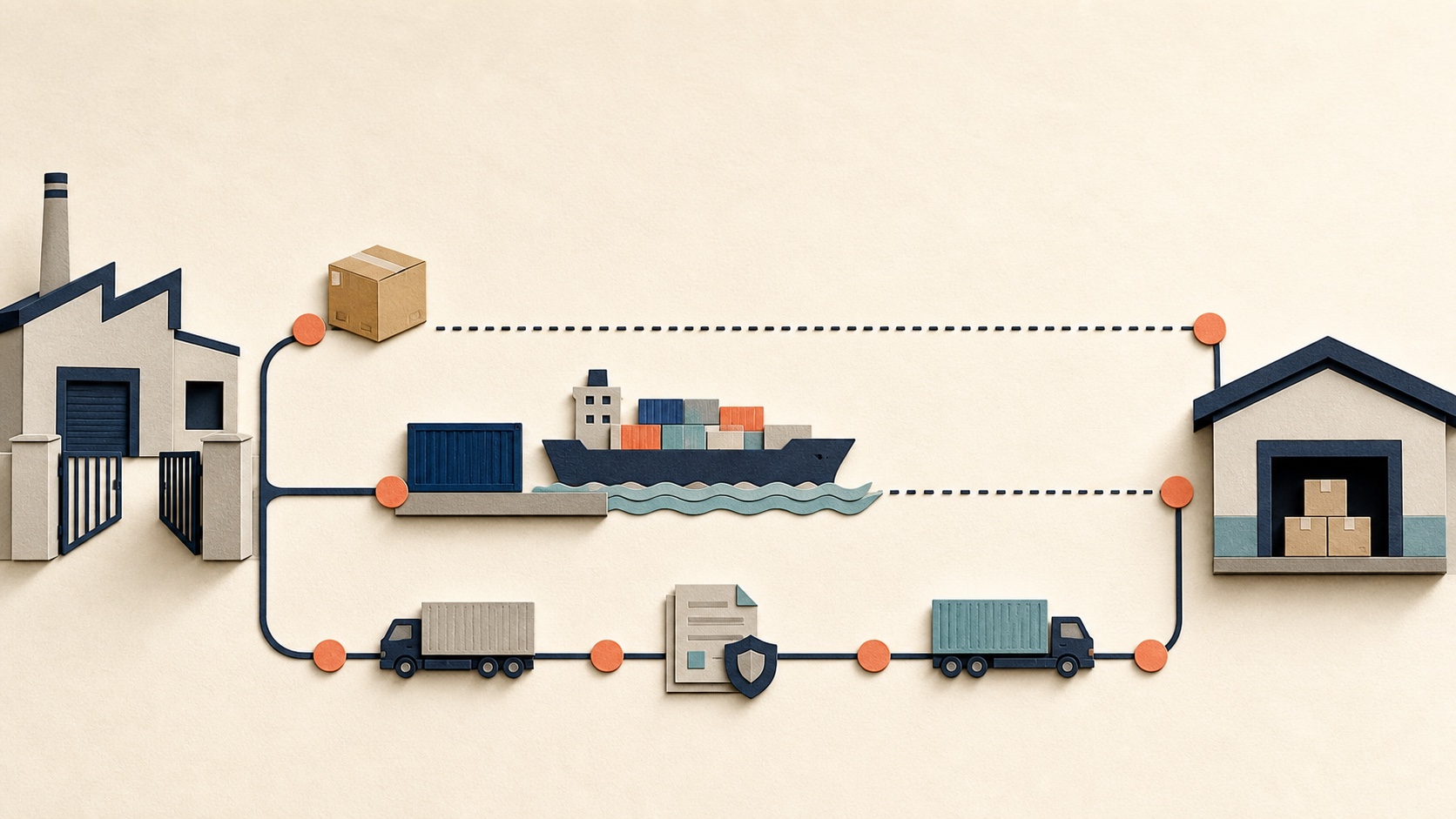
EXW, FOB and DDP are not three prices for the same service. Each term changes who must arrange transport, complete customs formalities, carry risk and pay particular costs.
For a buyer importing from China, the useful question is not “Which Incoterm is cheapest?” It is: which party can legally and operationally perform each step, and are the quotations built on the same scope?
This guide uses Incoterms® 2020. It explains the commercial hand-offs, but it does not replace the sales contract, customs advice or product-compliance review.
What Incoterms do—and do not decide
The International Chamber of Commerce describes Incoterms as rules that allocate three things between seller and buyer: obligations, risk and costs. They identify who arranges carriage or insurance where required, who handles export and import formalities, where delivery occurs and where loss or damage risk transfers.
They do not, by themselves, determine:
- when ownership or title passes;
- when or how payment is made;
- the product specification, warranty or acceptance criteria;
- customs classification, customs value or the final duty rate;
- which party satisfies product-safety, labeling or market-access rules;
- remedies for delay, nonconformity, force majeure or breach.
Write the rule, the exact named place or port and the version in the contract—for example, “FOB Shanghai, Incoterms® 2020.” A vague destination can leave the parties disagreeing about the actual hand-off and costs.
EXW vs FOB vs DDP at a glance
| Question | EXW | FOB | DDP |
|---|---|---|---|
| Delivery and risk transfer | Goods are placed at the buyer’s disposal at the named place, normally not loaded | Goods are delivered onboard the buyer-nominated vessel at the named port of shipment | Goods reach the named destination, cleared for import and ready for unloading |
| Export formalities | Buyer | Seller | Seller |
| Main carriage | Buyer arranges and pays | Buyer arranges and pays | Seller arranges and pays |
| Import formalities and duties | Buyer | Buyer | Seller |
| Insurance obligation under the rule | None | None | None |
| Unloading at destination | Buyer’s transport chain | Buyer’s transport chain | Normally buyer, unless the carriage contract includes unloading |
| Common control pattern | Maximum buyer control, including origin pickup and export | Buyer controls main freight after onboard delivery | Seller controls most of the route to destination |
This table is a decision aid, not a substitute for the complete ICC rules. The named point and the actual contracts with carriers, brokers and service providers still matter.
EXW: broad buyer control, but a difficult export hand-off
Under EXW, the seller makes the goods available at the named place. The buyer normally handles loading, origin transport, export clearance, main carriage, import clearance and destination delivery.
That can work when the buyer has a capable forwarder and a lawful export arrangement in China. It becomes risky when an overseas buyer assumes it can simply collect the goods but cannot complete export formalities or obtain proof of export. ICC guidance specifically warns that EXW can create practical problems with loading and export clearance and suggests considering FCA for international trade.
Before accepting EXW, confirm:
- who loads the truck and who bears loading risk;
- which entity will appear in and complete the export process;
- how the seller receives acceptable proof of export;
- whether origin handling, documentation and pickup charges are included;
- whether FCA at the seller’s premises would create a cleaner hand-off.
FOB: useful for onboard sea delivery, not a universal container term
FOB is a rule for sea and inland-waterway transport. The seller clears the goods for export and delivers them onboard the vessel nominated by the buyer at the named port of shipment. Risk transfers when the goods are onboard—not under the old “ship’s rail” wording.
The buyer arranges the main carriage, insurance if desired, destination charges, import clearance and final delivery. This gives the buyer visibility and negotiating control over the main freight while leaving export formalities with the Chinese seller.
For ordinary containerized or multimodal shipments, ICC’s selection checklist points parties toward FCA, because the seller often hands a sealed container to a terminal or carrier before it is loaded onboard. Incoterms® 2020 also provides an FCA option for the buyer to instruct the carrier to issue an onboard bill of lading to the seller when documentary-credit practice requires it.
Ask the supplier to name the exact port and identify which origin terminal, documentation, handling and loading charges are included. “FOB China” is not a sufficiently precise term.
DDP: one delivered price, but maximum seller responsibility
Under DDP, the seller carries cost and risk to the named destination, clears the goods for export and import, and pays applicable import duties. Delivery occurs with the goods ready for unloading. DDP is the only Incoterms® rule in which the seller takes responsibility for import clearance and tariffs.
The apparent simplicity can hide the hardest question: can the Chinese seller legally act, directly or through a valid structure, as required in the destination country? ICC guidance warns that import clearance can be physically or legally difficult for a foreign seller and suggests considering DAP or DPU when the seller should not handle import formalities.
A credible DDP quotation should identify:
- the exact named destination and whether unloading is included;
- the importer-of-record arrangement and customs broker;
- the HS classification and customs-value assumptions used;
- which duties, trade-remedy duties, taxes and customs fees are included;
- who handles product-compliance documents and agency filings;
- what happens if customs reclassifies the goods or assesses additional charges;
- the delivery-time assumptions, storage limits and exception charges.
DDP does not automatically require the seller to buy cargo insurance. Insurance obligations are expressly built into CIF and CIP, not EXW, FOB or DDP. The sales contract may add insurance separately.
Five red flags in a suspiciously cheap DDP quote
- No importer is identified. The seller says “our channel handles it” but cannot name the responsible importing entity or broker.
- No classification assumption exists. The all-in figure is offered before the product, materials, use and HS classification are understood.
- Tariffs are treated as one fixed percentage. Ordinary duty, trade-remedy duty, tax and customs fees are not separated.
- Compliance is confused with customs clearance. A cleared shipment is presented as proof that product-safety, labeling or market-access duties are satisfied.
- No exception rule is written. The quote does not explain storage, inspection, reclassification, remote-area delivery or failed-delivery costs.
A low DDP quote is not automatically improper. It is simply not comparable until the importing structure and cost assumptions are documented.
Compare quotations on one landed-cost worksheet
Convert each offer into the same destination and scope. Record at least:
- goods and packing;
- origin loading, inland transport and export handling;
- main freight and insurance;
- destination terminal and broker charges;
- customs value, classification assumption and duties;
- taxes and other government charges;
- destination delivery and unloading;
- inspection, compliance and document costs;
- contingency for delay or reclassification.
For U.S. imports, CBP says duty is generally assessed on the price paid or payable for the goods, excluding international freight and insurance, while additions such as packing, assists, royalties or selling commissions may need to be included. Do not mechanically use an EXW, FOB or DDP invoice total as the customs value; the importer and broker need the underlying cost evidence.
A practical selection sequence
- Check legal ability. Can the selected party complete export and import formalities in the relevant countries?
- Choose the control point. Does the buyer want to control origin pickup, main freight or only receive at destination?
- Match the transport mode. Use FOB only when onboard sea or inland-waterway delivery reflects the real hand-off; review FCA for containerized hand-offs.
- Name the exact place. Add the terminal, port or delivery address and Incoterms® 2020.
- Build a cost schedule. State every included and excluded charge instead of relying on three letters alone.
- Keep compliance separate. Assign product, labeling, testing and market-access responsibilities in the sales contract.
- Record exceptions. Decide who pays when customs, inspection or delivery differs from the original assumption.
Frequently asked questions
Is FOB or DDP better when importing from China?
Neither is universally better. FOB gives the buyer more control over main freight and import clearance. DDP can simplify delivery only when the seller has a transparent and lawful importing arrangement. Compare capability and scope before price.
Does DDP mean there will be no extra charges?
DDP assigns import clearance and applicable duties to the seller, but the contract still needs to define taxes, inspections, storage, reclassification and delivery exceptions. A three-letter term cannot document every contingency.
Who is the importer of record under DDP?
The DDP seller is responsible for import formalities under the Incoterms allocation, but the legal importer structure depends on destination-country law and the parties involved. Ask for the named importing entity and broker before relying on the quote.
Should container shipments use FOB?
ICC guidance generally points containerized or multimodal hand-offs toward FCA. FOB remains appropriate when the seller actually delivers the goods onboard the vessel at the named port.
Do Incoterms decide ownership or payment?
No. Ownership, payment schedule, quality acceptance and breach remedies belong in the sales contract and related documents.
Primary sources and limits
- International Chamber of Commerce, Incoterms® 2020 Q&A — what the rules allocate, delivery points, mode selection and EXW/DDP practical limits.
- ICC, Incoterms® 2020 checklist and flowcharts — FCA for containerized hand-offs, FOB for onboard maritime delivery and D-rule selection.
- ICC, Using the Incoterms® 2020 Rules to Manage Tariff Risk — customs-formality and tariff allocation.
- U.S. Customs and Border Protection, commercial-invoice value — price paid or payable, international freight and insurance, and additions to declared value.
- UK Government, customs valuation and Incoterms — valuation adjustments depend on the costs included in the invoice price.
Sources were checked on 21 August 2026. This guide paraphrases public guidance and does not reproduce the ICC rule book. Customs, tax and importer requirements vary by country, product and transaction; confirm the actual structure with the importer, broker and qualified advisers.